


 English
 中文简体
中文简体
Table of Contents
- 1 Mechanisms of Action in Cardiovascular Health
- 2 Antioxidant Synergy and Systemic Benefits
- 3 Application Trends in Food and Health Industries
- 4 Frequently Asked Questions (FAQ)
- 4.1 1. What is the difference between Ubiquinone and Ubiquinol in powder form?
- 4.2 2. Why is bioavailability the biggest concern with CoQ10?
- 4.3 3. Can SPH-level technology be used for water-based drinks?
- 4.4 4. How should bulk CoQ10 be stored to maintain potency?
- 4.5 5. Does Coenzyme Q10 interact with other nutrients?
In the rapidly advancing field of nutritional science, Coenzyme Q10 Powder (CoQ10) remains a cornerstone ingredient for metabolic and cardiovascular health. As a critical component of the mitochondrial electron transport chain, CoQ10 is essential for Adenosine Triphosphate (ATP) production. However, for B2B procurement and product formulators, the primary challenge remains its inherent lipophilicity and poor intestinal absorption. Cocrystal Technology Co., Ltd., founded by distinguished scientists from national laboratories, addresses these limitations through advanced cocrystal technology. By engineering the crystalline structure of active ingredients, we provide a high bioavailability Coenzyme Q10 formulation that significantly enhances solubility and stability, ensuring optimal nutrient delivery for human and animal nutrition.
Mechanisms of Action in Cardiovascular Health
The cardiovascular benefits of Coenzyme Q10 Powder are primarily derived from its role in bioenergetics and its presence in the myocardial tissue. CoQ10 exists in two redox states: ubiquinone (oxidized) and ubiquinol (reduced). In the heart, which has the highest energy demand of any organ, CoQ10 facilitates the transfer of electrons to generate energy. According to the 2024 Global Heart Health Ingredients Report by the World Heart Federation (WHF), the integration of high-purity CoQ10 in clinical nutrition has shown a measurable impact on endothelial function and the management of oxidative stress in cardiac myocytes. Using a pure CoQ10 powder for heart health supplements ensures that the body receives the necessary raw material to support cardiac output and mitigate the depletion caused by certain lipid-lowering medications.
Source: World Heart Federation - 2024 Cardiovascular Nutrition Global Report
Comparative Analysis: Energy Production vs. Cellular Protection
While CoQ10 is famous for energy synthesis, its role as a lipid-soluble antioxidant is equally vital for protecting LDL cholesterol from oxidation, which is a key step in preventing atherosclerosis.
| Mechanism | Bioenergetic Function (Ubiquinone) | Antioxidant Function (Ubiquinol) |
| Primary Site | Inner Mitochondrial Membrane | Cell Membranes and Plasma Lipoproteins |
| Action | ATP (Energy) Synthesis | Neutralizes Reactive Oxygen Species (ROS) |
| Clinical Target | Heart Failure and Fatigue Management | Lipid Peroxidation and Anti-aging |
| Benefit of Cocrystal Technology | Enhanced ATP output via better absorption | Superior stability against oxidation in storage |
Antioxidant Synergy and Systemic Benefits
Beyond the heart, Coenzyme Q10 Powder serves as a premier antioxidant that regenerates other essential nutrients, such as Vitamin E. This synergistic effect is crucial for cellular defense mechanisms. In the personal care and nutraceutical industries, there is a growing trend toward bulk Coenzyme Q10 powder for anti-aging products, as topical and oral administration can reduce the depth of wrinkles caused by photo-aging. According to the 2025 International Journal of Cosmetic Science Technical Update, the transition toward stabilized CoQ10 complexes has improved the efficacy of topical formulations by ensuring the active ingredient remains potent throughout the product's shelf life.
Source: International Journal of Cosmetic Science - 2025 Formulation Breakthroughs
Comparative Analysis: Standard CoQ10 vs. Cocrystal CoQ10
Standard CoQ10 exhibits poor solubility in both water and oil, leading to low absorption rates; however, cocrystal-engineered versions solve this by modifying the physical properties without changing the chemical nature of the molecule.
| Property | Standard USP Grade CoQ10 | High bioavailability Coenzyme Q10 formulation |
| Solubility | Very Low (Lipophilic) | Significantly Enhanced (Water-dispersible options) |
| Bioavailability | 1% - 5% absorption rate | 3x - 5x Increase in plasma concentration |
| Stability | Sensitive to light and heat | High (Improved crystalline lattice) |
| Application | Softgels only | Capsules, Tablets, and Functional Beverages |
Application Trends in Food and Health Industries
The market for Coenzyme Q10 Powder is shifting from simple supplements to functional "lifestyle" products. We are seeing a surge in demand for water soluble Coenzyme Q10 powder for beverages, as consumers seek heart health benefits in convenient formats like energy drinks and nutrient-enhanced waters. Cocrystal Technology Co., Ltd. empowers these applications through our platform, ensuring that nutrients perform optimally in diverse matrices. As an industry leader, we provide premium active ingredients tailored for human nutrition, animal nutrition (supporting vitality in aging pets), and personal care. Our technology platform enables us to offer wholesale Coenzyme Q10 for functional food brands that require heat-stable and easily integrated powders.
- Human Nutrition: Precision-dosed tablets and capsules with enhanced absorption profiles.
- Animal Nutrition: Vitality supplements for senior dogs and performance horses.
- Functional Beverages: Transparent, water-dispersible CoQ10 for "smart" drinks.
- Personal Care: High-purity powders for dermo-cosmetic serums and creams.
Frequently Asked Questions (FAQ)
1. What is the difference between Ubiquinone and Ubiquinol in powder form?
Ubiquinone is the oxidized form used in most Coenzyme Q10 Powder products due to its stability. Ubiquinol is the reduced form. While both are effective, Cocrystal Technology focuses on making the stable Ubiquinone form as bioavailable as Ubiquinol through crystal engineering.
2. Why is bioavailability the biggest concern with CoQ10?
CoQ10 has a large molecular weight and is insoluble in water. Most pure CoQ10 powder for heart health supplements passes through the digestive tract without being absorbed. Enhancing bioavailability is the only way to ensure the heart receives the benefits.
3. Can SPH-level technology be used for water-based drinks?
Yes. By utilizing cocrystal methods, we can produce water soluble Coenzyme Q10 powder for beverages that does not precipitate or cloud the liquid, allowing for clear functional water formulations.
4. How should bulk CoQ10 be stored to maintain potency?
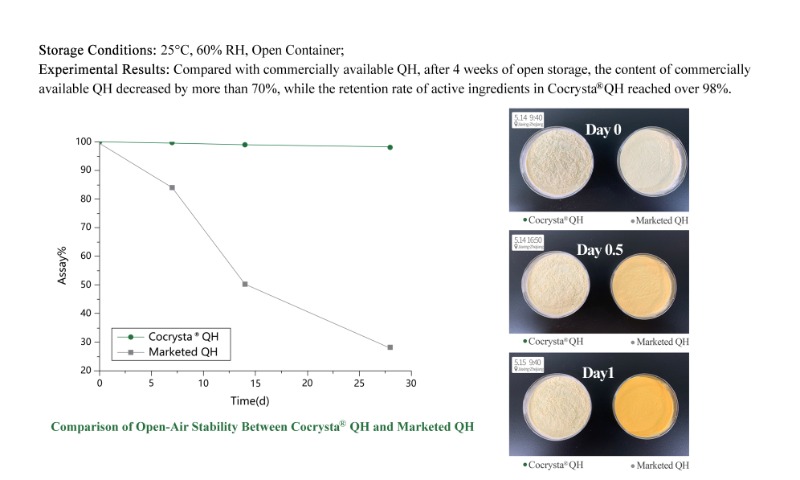
Even though our bulk Coenzyme Q10 powder for anti-aging products is engineered for higher stability, it should still be stored in a cool, dark place in airtight containers to prevent any UV-induced degradation.
5. Does Coenzyme Q10 interact with other nutrients?
CoQ10 works synergistically with Vitamin E and Omega-3 fatty acids. Wholesale Coenzyme Q10 for functional food brands often includes these combinations to maximize antioxidant capacity and cardiovascular support.


